What Should Music Teachers Do?
Have you ever had this situation? Your student arrives with a selection they’d like to learn that’s clearly beyond their current level. They absolutely can’t wait to get started. As music teachers, we know what could happen next. On the one hand, we worry that students’ decision may result in technical strain, inefficient habits, or even long-term damage. On the other, we recognize there’s something powerful at work: curiosity, ambition, and personal connection to music.
So what do we do when students choose repertoire that’s clearly beyond their current level of mastery?
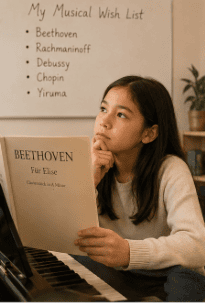
Step One: Celebrate! Students who come with their own musical wish lists is a good thing. Not a bad thing or something downplay and put aside, even when their choice is beyond their current level. When students make musical choices, it’s obvious they’re connected to music. They have musical interests that reflect what inspires them, what they listen to, and how they see themselves as music makers. Ignoring students’ natural impulses can easily dampen their musical enthusiasm. Discouraging their musical interests can send the message that teachers don’t understand or welcome students for who they are. That’s not what we want to accomplish - even when students' choices are well beyond their current mastery.
We want to let students know we’re 100% behind their journey. We’re here to help out - not get in their way.
Step Two: Be Open. I’m always open to seeing how far students can get with their own musical interests. Sometimes they get further than I anticipated. With support from me, students may achieve more than their current level might suggest - especially when I help students approach the music with more informed strategies than they might use on their own.
On certain occasions, it may be enough for students to just learn one line like my beginner student Connor. For him, learning the first line of Für Elise was deeply satisfying and motivating. It gave him a sense of connection to the music without getting bogged down by details beyond his ability. On some occasions, students’ choices turn out to be less engaging than they anticipated. Students indicate they’d like to move on to something else. I’m not worried about students necessarily finishing the piece. There’s real value in giving things a try. Moving on to other pieces isn’t a failure. It’s part of a healthy learning process.
Step Three: Ownership. Last year my elementary student Alyssa told me she wanted to learn a selection from Imagine Dragons. That meant using her most accessible strategy - learning by ear. We started by going online and listening to the selection on YouTube. Then checked to see how much of the song Alyssa could sing with words and zeroed in on the section she was most comfortable with. Finally I found the first note on the piano and demonstrated it for her with an appropriate fingering. For elementary students like Alyssa, the easiest learning process starts with making sure she’s got ownership of the song inside her ears.
With my student Angie the process is quite different as her reading skills are sufficiently developed. And over the years, she’s always taken ownership by learning how to find sheet music online and at the music store. Her most valuable skill is knowing how to look out for keywords like “easy version”, “intermediate”, and “advanced”. Through her own trial and error process, Angie has learned that not all pieces suit her, even when the level is appropriate. Make sure students have ownership of learning strategies that work for them.

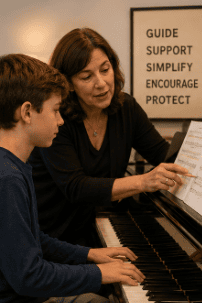
Step Four: Protection - I also want to protect my students from risks they can’t see for themselves. Technical strain, inefficient movement patterns, or repertoire that pushes the body beyond safe limits require careful monitoring. Left unchecked, certain repertoire choices can do more harm than good. That’s where our professional judgment comes in. We provide guidance. We simplify passages, isolate manageable sections, or reframe the goal entirely.
When my teenage student Renae indicated she wanted to learn Mozart’s Turkish March, I could see she was barely prepared to handle the octave sections. Through discussion and demonstration, Renae understood the importance of gentle and hand-friendly practicing routines. For my elementary student Alex, I responded to his interest in performing Liszt’s La Campanella by quickly arranging a one-page simplified adaptation. For both Renae and Alex, their musical interests aren’t organized by levels of repertoire. The music they want to explore is the music that’s bubbling in their ears not on a list of graded pieces. When students reach beyond their current level, they reveal something about their musical identity. As music teachers, we have the privilege and pleasure of meeting them where they are, helping them to explore safely and productively.
In Conclusion - Many years ago, a teacher colleague shared something that has stuck with me ever since. She said, “If a student truly wants to learn a piece, there’s really nothing teachers can do to stop them. And why would we? Isn’t the whole point of music lessons for teachers to help students so they may make musical explorations without their teacher’s assistance?”
I’m still nodding my head in agreement.
How do you respond when students request learning something beyond their current mastery?
How do you protect students long term health while recognizing the music that excites and energizes them?
Do you have colleagues who might appreciate reading this blog? Please feel free to share it with them.
If this exploration into students reaching beyond their current mastery has got you thinking, I’d love to hear from you. Click HERE to send me an email message.
This is your invitation to keep the conversation going....