Authoritarian or Empathetic
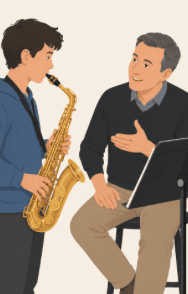
I’ll start with a scenario that music teachers frequently encounter — the student arrives and we can tell from their body language that practicing over the last week hasn’t gone all that well. So what should we do? Do we say something like “Well… if you don’t get your practicing done at home, we’ll turn your lesson into a practice session.” Or do we respond with “I notice your practicing has become challenging in recent weeks. How can we make the most out of your lesson time? What would be most helpful?” Either way, there’s follow up in our response, but the difference is significant. And that difference can be described in terms of authoritarian or empathetic communication. An authoritarian teacher tells students what to do and expects them to comply. Whereas an empathetic teacher communicates our understanding and collaborates with students.
Compare the following authoritative and empathetic statements:
“Excuses aren’t allowed.” & “Tell me what’s getting in the way.”
“Play it like this.” & “Play it your favourite way, my favourite way, the composer’s favourite way.”
”You should know this by now.” & “Let’s brainstorm some ways to make progress.”
“I need to see what we talked about last week.” & “What should I listen for - your dynamics or steady beat?”
The challenge for today’s music teachers is that we come from a long history of authoritarian communication. That’s our background. So the authoritative words of previous music teacher generations might come out of our mouths before we even know it. Or we might think we’ve become empathetic communicators because we use nicer words. So I’ll gently point out that empathetic communication is more than authoritarian communication delivered in a kinder tone of voice.
A teacher can sound warm and gentle while dismissing a student’s perspective - that’s still an authoritarian approach. Just as a teacher can be firm and direct while showing genuine empathy. The goal isn’t to find better words to make students do what we want or control their journey. It’s about communicating in ways that ensure students feel understood, think for themselves, and participate more fully in their own musical development. Empathetic teachers know how to deliver good news and bad news while respecting who our students are. Empathetic teachers haven’t abandoned expectations. We try to understand our students’ situations and help students take responsibility so that empathy and accountability work together.

As studio teachers, we can ask ourselves:
1. Are my words a continuation of our history with authoritarian communication? What can I do to be more attentive to how I communicate empathetically?
2. How can I use my words to help students develop understanding, agency, and the ability to make thoughtful decisions? What might get in the way?
For today’s music teachers, we have an opportunity to permanently change the tone of communication. Do we treat the student as a person we aim to understand? Or do we treat the student as a problem we aim to correct?
When students struggle with practicing as in the opening scenario, teachers can choose what we’ll say. I’d like to suggest we permanently shelve strategies like the first response that carries undertones of shame, embarrassment, and punishment. Let’s open doors that support students through reflection, collaborative problem solving, and meaningful musical explorations. Because how music teachers communicate has far-reaching implications. It shapes what happens in today's lesson. And it also supports the kind of long lasting musical relationship students build for themselves.
Do you have teaching colleagues who might appreciate reading this blog? Please feel free to share it with them.
If this exploration into authoritarian and empathetic communication resonates with you, I’d love to hear from you. Click HERE to send me an email message.
This is your invitation to keep the conversation going....